We use cookies to ensure our site functions properly and to store limited information about your usage. You may give or withdraw consent at any time. To find out more, read our privacy policy and cookie policy.
Manage Cookies
A cookie is information stored on your computer by a website you visit. Cookies often store your settings for a website, such as your preferred language or location. This allows the site to present you with information customized to fit your needs. As per the GDPR law, companies need to get your explicit approval to collect your data. Some of these cookies are ‘strictly necessary’ to provide the basic functions of the website and can not be turned off, while others if present, have the option of being turned off. Learn more about our Privacy and Cookie policies. These can be managed also from our cookie policy page.
Strictly necessary cookies(always on):
Necessary for enabling core functionality. The website cannot function properly without these cookies. This cannot be turned off. e.g. Sign in, Language
Analytics cookies:
Analytical cookies help us to analyse user behaviour, mainly to see if the users are able to find and act on things that they are looking for. They allow us to recognise and count the number of visitors and to see how visitors move around our website when they are using it. Tools used: Google Analytics
Share Growing Livable Neighbourhoods on FacebookShare Growing Livable Neighbourhoods on TwitterShare Growing Livable Neighbourhoods on LinkedinEmail Growing Livable Neighbourhoods link
Recently, the British Columbia Provincial Government imposed changes that require municipalities to update zoning and planning tools to improve housing availability over the next 20 years. In response, the City is updating the tools we use to plan our communities, including our Official Community Plan (OCP) and Zoning Bylaw. As we plan for future growth, we're committed to keeping our city welcoming, friendly and vibrant.
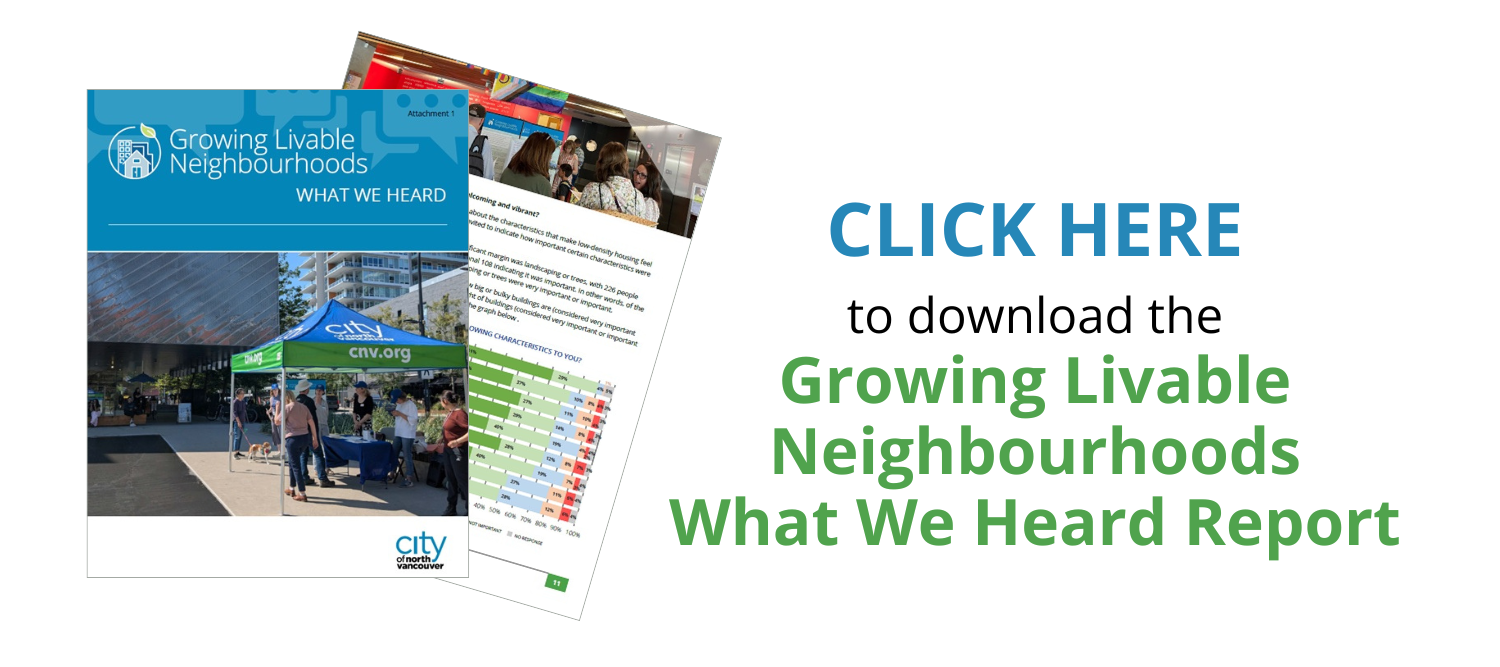
In July 2025, the City conducted a series of community engagement activities that included 6 pop-ups, a Community Workshop, a Town Hall meeting, and an online survey. In total, over 600 people participated in activities and gave their feedback. These activities are now closed and City staff have compiled the data collected through engagement in a What We Heard Report that can be downloaded here.
What changes are City staff proposing to Council?
The City is currently exploring two strategies to grow in a livable way:
Adding more low-density homes, which have also been called multiplex, "gentle infill housing" or “missing middle” housing that include up to 6 units on a property. Low-density houses might look like duplexes, fourplexes, townhouses, or rowhouses.
Rezoning some City-owned landsto plan for future higher-density developments.
To learn more about the proposed changes, please explore the linked webpages above, browse through City staff's Oct. 6th presentation to Council, or access Council minutes and video (published a few days after Council meetings).
Recently, the British Columbia Provincial Government imposed changes that require municipalities to update zoning and planning tools to improve housing availability over the next 20 years. In response, the City is updating the tools we use to plan our communities, including our Official Community Plan (OCP) and Zoning Bylaw. As we plan for future growth, we're committed to keeping our city welcoming, friendly and vibrant.
In July 2025, the City conducted a series of community engagement activities that included 6 pop-ups, a Community Workshop, a Town Hall meeting, and an online survey. In total, over 600 people participated in activities and gave their feedback. These activities are now closed and City staff have compiled the data collected through engagement in a What We Heard Report that can be downloaded here.
What changes are City staff proposing to Council?
The City is currently exploring two strategies to grow in a livable way:
Adding more low-density homes, which have also been called multiplex, "gentle infill housing" or “missing middle” housing that include up to 6 units on a property. Low-density houses might look like duplexes, fourplexes, townhouses, or rowhouses.
Rezoning some City-owned landsto plan for future higher-density developments.
To learn more about the proposed changes, please explore the linked webpages above, browse through City staff's Oct. 6th presentation to Council, or access Council minutes and video (published a few days after Council meetings).
August 2025: This survey was available until July 31st, 2025 and is now closed. The City of North Vancouver thanks everyone who participated.
Share (CLOSED) What makes for livable, vibrant housing? on FacebookShare (CLOSED) What makes for livable, vibrant housing? on TwitterShare (CLOSED) What makes for livable, vibrant housing? on LinkedinEmail (CLOSED) What makes for livable, vibrant housing? link
Page last updated: 14 Dec 2025, 10:48 AM
Follow Project
Stay informed
Subscribe for project updates
Timeline
Community engagement begins
Growing Livable Neighbourhoods has finished this stage
July 2025
City staff conduct pop-ups, a community workshop and town hall meeting to collect feedback.
Data analysis & review
Growing Livable Neighbourhoods has finished this stage
August - September 2025
Staff analyze engagement findings and integrate results into City planning tools.
Presentation to Council
Growing Livable Neighbourhoods has finished this stage
October 6, 2025
Council meets to consider bylaw changes to the City’s planning tools.
Public Hearing
Growing Livable Neighbourhoods has finished this stage
November 17, 2025
Community members are invited to City Council to share feedback with Council on the proposed updates.
Final Council decision
Growing Livable Neighbourhoods is currently at this stage
December 8, 2025
Council makes a final decision on the proposed updates.